Thursday, August 11, 2011

Chinese Skeleton #3

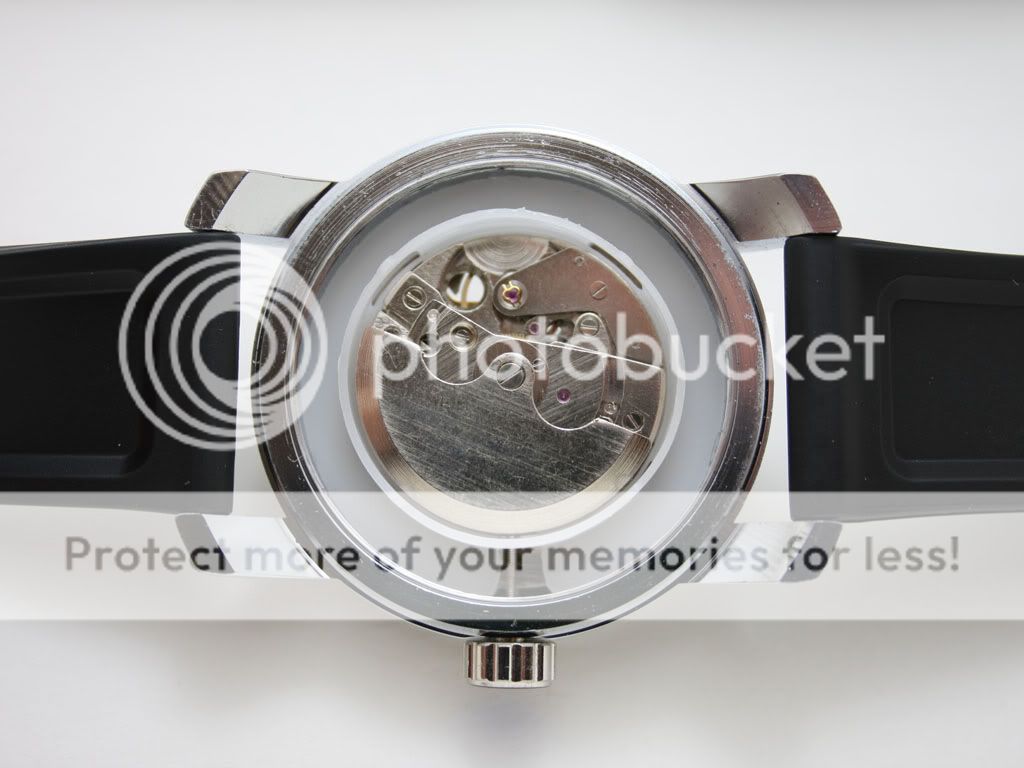
I just received my third Chinese skeleton watch, this time from DealExtreme, a Wilon model 968-1. It's a fairly large watch (42mm) on a light-weight folded link bracelet, but it still balances well on the wrist. Really, it's very comfortable. The display case back and probably the bracelet, too, are stainless, though the case is plated base metal. The hands are thick and lumed, which makes it very readable. Many skeleton watches, like my Elgin, are not; the hands get lost against the busyness of the movement. And it seems to keep decent time.

But the watch did not come with the engraved movement that the listing pictured. That was one of the main reasons I ordered it. Instead it has a very plain skeletonized Chinese standard movement. Also, the bracelet has rough sides and the sizing pins are so loose you can push them out with your fingers; the dial is misaligned, rotated slightly clockwise; the winding stem is a bit stiff; and I'm not sure it really autowinds. With most of these cheap Chinese autos, the rotors just do not turn like they should (too light).

I'm very disappointed that it came without the engraved movement. But it has a catchy Breitling Navitimer style, and is very light and comfortable. I like it enough, in fact, that may it may just get a turn as my new favorite beater.

Monday, August 8, 2011

Cuffs

Wearing a watch with a long-sleeved shirt is problematic for me, and I wear long-sleeved shirts most of the time. I have 8.5 inch wrists, quite large, and I like my watches sized loose. Consequently, most of my watches won't fit comfortably, or won't fit at all, under most of my cuffs. Many other men must have this same problem. What to do?

Style guru Alan Flusser maintains that only thin and inconspicuous watches should be worn with formal dress. A bulky sports watch worn with a dress shirt, he says, is a gaff. Well into the 90s, most men wore very small and thin watches, compared to those of today. They fit under cuffs just fine. But that looks stylistically to a past era.

Big sports watches are the predominant style now, even with dress
shirts. It takes confidence today for a thick-wristed man to wear a vintage 32mm watch. Many of my vintage watches look girly compared to my new ones, even though I don't really have or like overly big watches (say, over 42mm).

In the high-style era of the 30s through 60s, as men transitioned from pocket to wrist watches, watchmakers competed to see who could make the thinnest watch. At the same time, men often wore generous French cuffs and had shirts tailored to fit, including bespoke cuff sizing. Fitting a watch under you cuff was not at all an issue. The Italians introduced tight-fitting cannon cuffs, but style mavens like Gianni Agnelli just took to wearing their watches over them. You still see this occasionally, but it's hardly conventional. GQ says that the "only cuff [a watch] should be worn over is that of a wet suit."

The clothier Luciano Barbera, with watch worn over shirt cuff.

Most men, it seems, just bunch their sleeve up above their watch. I can't stand this myself. I either roll up my sleeves or leave my left cuff unbuttoned. But these are workarounds, not solutions. The real solution is of course to have your cuffs tailored to size. If that's not in your budget (it's not in mine), some men just relocate the left sleeve button out further toward the cuff edge, and may also have it shanked (hung from a longer, knotted thread). This can give you an extra half inch or more.

But frankly, as an ideal, Flusser certainly has it right. If you're dressing up, just go thin.

Addendum:  The photo above is many years old, but I just came across a recent one that shows Luciano still wearing his watch over the cuff.


Thursday, August 4, 2011

Took Lemonhead for a Walk Tonight

My most expensive watches I rarely wear, and therefore my Seiko Kinetic 200m diver (SKA367P1) almost never leaves my watch drawer. But I decided it needed some exercise, so I took it along on my evening constitutional tonight. Seiko's kinetic movements are quartz, but derive their power from a mechanical autowinder, so it needed a good walk just to get its heart beating. It's a big chunk 'o steel (216g), and just lugging it around is mild exercise in itself. But it's not too nice to wear, even just exercising, I've decided. Rather it's too nice not to wear.

Monday, August 1, 2011

Elgin Skeleton Watch: Round Two

I sent back the DOA Elgin watch I received about two weeks ago, and the seller refunded my money. But he also sent me a replacement. I ate almost $10 in shipping on the return, plus the time and grief, but this was more than fair. So, round two (with prettier pictures).


This unit works perfectly. I've described it before, but to expand a bit: the watch is heavy. More than 50g (=ca. 40%) heavier than my Seiko 6309-7290. Fortunately it balances well on its solid bracelet. Still, I wish it were a bit lighter. My second gripe is that it honestly looks about as cheap as it is. A bit blingy, a bit overdesigned, a bit Wal-mart. My third gripe is that the silver hands get lost against the busy silver skeleton movement. This a common problem with skeleton watches.

But I'm still glad this watch came back. I bought it for its skeletonized Sea-gull ST-16 movement, and it is indeed a beautiful movement, beautifully displayed. Many mechanical watches have display backs but few merit them. This one most certainly does.

Saturday, July 30, 2011

Hai Fuyate!

Yes, a third Fuyate has landed. These Fuyate watches may be churned out of the same junk watch factories as all the other bottom-feeding Chinese brands, but they tend to be somewhat smarter looking. I purchased this one on the whimsiest of whims, because it was the least ugly open heart design I've come across lately. Perhaps not a great commendation, but there you have it.

Yes, I finally broke out my DSLR and light tent.

An open heart watch is one with the balance wheel exposed to view through the front of the dial. It's great fun to watch it beating away, just as with a skeleton watch, but because they are otherwise normally dialed, open heart watches are easier to read and a bit less blingy. But I find most fairly unappealing. The open heart is often called a tourbillon in listings (including the one for this watch), but that is incorrect. Even cheap Chinese versions of real tourbillon watches usually start about $1000. This watch was $21 shipped.

It measures about 44mm across and is perhaps 18mm in thickness. Quite chunky. The hands and indices are blued, which looks nice against the white dial, and all the hands are (weakly) lumed. It has three sub-dials. At 3:00 is a 24hr sub, at 6:00 a day-night indicator, and at 9:00 the open heart. It has a solid stainless back (no gasket), which is fine, since the unbranded movement is nothing to look at. But here it is anyway:


The movement seems to run well, but the quality otherwise is not great. The plating of the mystery metal case is poor and pitted, the case back very thin, and dial and surround look cheap. The hands are less bad, and it all looks fine if you do not scrutinize. The only glaring oddity is that a very large opening has been machined into the 9:00 side of the case, and then filled with black epoxy. Perhaps it's a misguided attempt at decoration. More likely is that this same case is used for other models where it serves a function, but here is just filled in. Not sure, but it still looks fine at a distance, especially with the strap I'm using.

The watch came on the usual PU leather croco-grain strap, but I purchased a cheap rubber strap separately to replace it. It's great and suits the watch, which is very comfortable on it. The watch I like, but this strap I love.

Thursday, July 28, 2011

Fuyate #2

I received another direct-from-China watch, once again branded Fuyate. I've found several Fuyate-branded watches on eBay that are more stylish (or at least, less ugly) than most of their kin, and they're very inexpensive. This one was $12.50 shipped.

Seller pic.

It is flieger-styled, with a fluted coin-edge bezel, black dial, medium-large numerals, and upright triangle index at 12:00. It's just 40mm across but feels a bit larger, probably because the bezel is thin and the dial large. An unadorned automatic Chinese standard movement may be seen through the display back. The timekeeping is decent. It winds perfectly and the date quick-set works, though the autowinder is dodgy. I actually like that the rotor is marked with a small Chinese communist star, which others have found as well in watches from this brand.

It looks good from a distance, but is a very cheap watch. The crystal and case back window are both plastic, and the base-metal case is not well finished. The dial looks cheap. The indices have some spots and marks, and the triangle at 12:00 has a slightly bent corner, though the hands are decent and even lumed. It came on the standard Chinese croco-grain PU leather strap, which I replaced with a Bond NATO from my parts box. It's a fetching combo, really, and makes for a fine-looking beater. It's not perfect, but it's really not bad. Not bad at all.

Tuesday, July 26, 2011

Beobachtungsurhen

I made mention the other week of WW2-era aviator watches, the most classical and pure examples being those used by the Germans and called Beobachtungsurhen. I linked out before to one short description, but here is a fuller overview from an old watch review on Equation of Time by Mort Schwartz (now archived on PMWF):
    The Beogachtungsuhr model, often referred to as the “B-Uhr,” used a design specified for the German Luftwaffe and was produced by IWC, Lacher & Co. (Laco), Stowa, A. Lange, and Gerhard Wempe. A standard common movement was not used by the contractors. Stowa, for example, utilized a movement based on Unitas that included a swan neck regulator. Lacher used a Durowe cal. D5 movement, while Lange used its own cal. 48/1 movement and Wempe used a Thommen (Waldenburg) cal. 31 movement. And all of these watches were manual wind.

    The translation of the term, Beogachtungsuhr, strictly, is “Observer’s” or “Observation Watch,” but many collectors agree that a more descriptive label is “Navigator’s Watch,” and I have seen some mention of it as a bombardier’s watch. Interestingly, the watch was not issued to navigators and possibly to other members of the air crew, as part of their regular uniforms and equipment allotment, but, instead, “loaned” to them just before they went out on a mission. The watch then had to be returned if they returned. One can wonder how the watches faired in plane crashes. The watches were fitted with extra long leather straps because they were often strapped over the sleeves of leather jackets just as has been done more recently for the same kind of reason with some of the watches provided to astronauts. They, of course, would strap their watches over the bulky sleeve of a space suit.

    The model most commonly referred to in my research is the mammoth IWC “Large 52 S.C. Calibre Pilot’s Watch.” S.C. is the abbreviation for “second au centre,” central seconds hand, or what we usually term a sweep seconds hand. I have never seen the actual model, but the literature indicates that the size of this watch was about 55mm, which is the same size as the watches produced by the other four suppliers. IWC took its manual wind Cal. 52 pocket watch movement, with 16 jewels and 18,000 beats per hour, and a swan neck regulator, to produce this wristwatch. As just indicated, the conversion also included adding a center sweep seconds hand.

    Other features, as with the ones produced by the other four suppliers, included an extra large crown to facilitate setting time and winding and hacking. IWC added an inner plate to shield the movement against magnetic fields. The history of this model does not end here. This same movement was used in wrist watches made for the British forces, and I have read that they were used by the British navy as a deck watch. The models made for British use were designated with “Mark”, and we see that same label used in early and current production runs of IWC, such as the Mark X and XV. Jaeger-LeCoultre also produced these or similar watches for the British armed forces.

Sunday, July 24, 2011

The Daily Beater

Choice can sometimes be a burden when you have a drawer full of watches, so every enthusiast has a watch or two that you reach for by default when you just can't be bothered to give it any thought. The criteria are probably the same for most of us. The watch has to be comfortable, versatile and, frankly, one you are unconcerned about damaging. Otherwise, it wouldn't be a beater.

Right now I have three beaters that together are found on my wrist more than half the time, probably much more. The first is my one dollar mechanical on a green NATO strap. It's my true beater beater, perfect for mowing the lawn or working on the garbage disposal. It keeps good time, looks decent, is extremely comfortable and all but worthless.

My second beater is my Seiko 6309-7290 diver. For such a top-heavy watch, it's surprisingly comfortable on its current Jubilee bracelet. As Seiko divers go, it's nothing special, but even the lowliest Seiko diver looks great and goes great with anything from a sport coat to swim trunks. Of course it's waterproof, and probably bombproof.

But one of my most worn watches remains my very first mechanical, an Invicta 8926 (review). This is Invicta's single most popular wristwatch. It's an homage of the Rolex Submariner, though the most recent version (mine) has adopted a scalloped bezel like the Omega Seamaster.


The Invicta's Miyota 8215 automatic movement keeps great time and is very robust, one of the best basic automatic movements made (comparable to the ETA 2824-2). Its solid link oyster bracelet balances the substantial 40mm case quite well. It's heavy (ca. 150g), but not too heavy; big, but not too big; a bit blingy, but unlike most Invictas, not too blingy. My only complaint is that the polished center links on the bracelet get scratched up in no time. But that might almost be seen as a desirable feature, because once you scratch up your watch, you're no longer afraid to really wear it. To make it a beater.

Saturday, July 16, 2011

There Is Leather, and There Is Leather

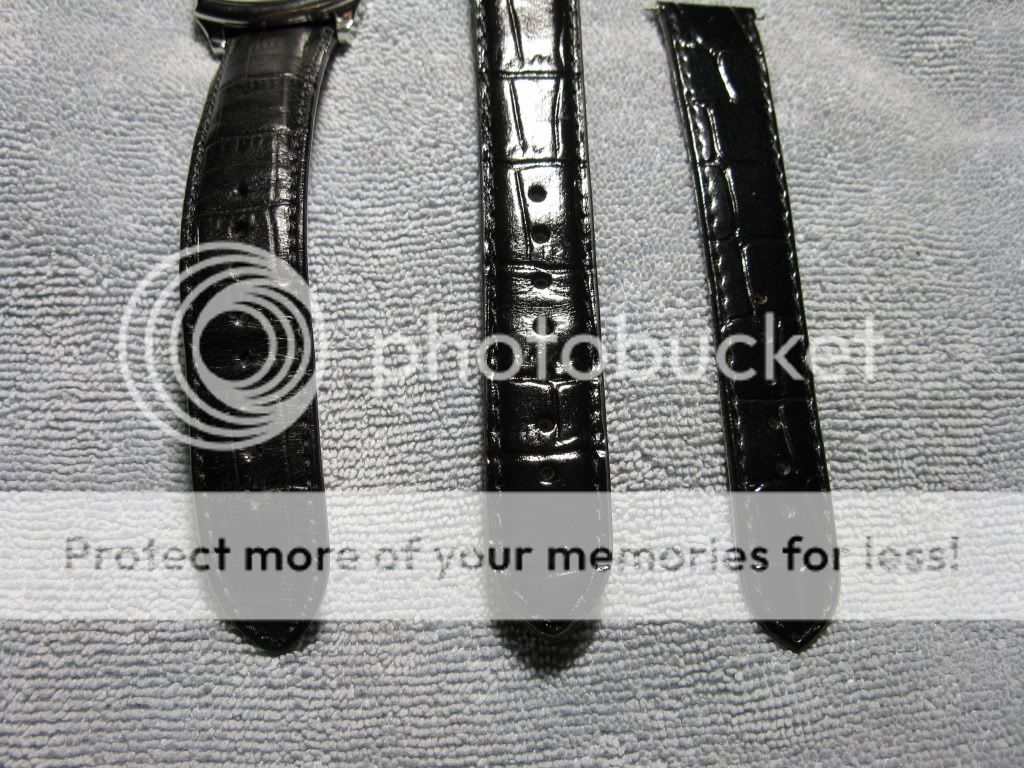
I've purchased four cheap Chinese mechanical watches lately that have all come on virtually identical black, crocodile-grain leather straps. All are stamped identically, "Genuine Leather." If I compare them to a similar Hamilton strap—most certainly genuine leather—they are much more glossy and in other obvious ways dissimilar to it. And if I compare them to a junk croco-grain vinyl strap, all are similarly slick and glossy on the croc side. But otherwise, the "Genuine Leather" straps seem in comparison to indeed be sort of leather. To confuse things more, some listings call them "PU leather." Huh?


L-R: Genuine top-grain Hamilton croco-grain strap; a PU (or, bycast) leather croco-grain strap; and a vinyl croco-grain strap. (Now that is a boring picture.)

Turns out there are degrees of leatherness. My Hamilton strap, on both its front and back sides, is some version of top grain leather. Top grain is just what it sounds like, leather taken from the outside top (hair side) of a leather hide. It's the outside of the hide that contains the grain, "the pores, wrinkles and other characteristics which constitute the natural texture of the leather." Most top grain leather has been sanded down to remove blemishes and "corrected" through dying and imprinting a new grain, like the croc grain of my Hamilton strap. But even though it is heavily corrected, this top grain strap quickly started breaking in, conforming to my wrist, and developing some patina on the wrist side.

But tanners can make a hide go much further by splitting it horizontally, which may be done as many as four times. So split leather is the "lower (inner or flesh side) layers of a hide that have been split away from the upper, or grain, layers." Split leather of course has no grain and is not as tough as top grain. It is often napped and used as suede.

PU leather, more commonly called bicast/bycast in the West, is split leather that has been bonded with a surface layer of polyurethane, into which may be molded a grain like (here) crocodile. So PU or bycast leather is just plastic with a leather backing. This is why my PU leather and my vinyl straps are almost identical on the outside. Some countries do not even permit manufacturers to label bycast as leather.

So in the UK, New Zealand and elsewhere, my PU (bycast) leather straps cannot legally be marked "Genuine Leather." Bycast leather is better seen as an imitation leather that contains leather byproducts. Bycast is very inexpensive, as little as $1.00 per square meter. If you own a cheap leather chair, it is almost certainly bycast. Same for Payless-grade leather dress shoes, etc. I would not say bycast is evil, but my bycast straps are only minimally wearable. They look and feel plastic because they mostly are plastic. In shoe terms, they are most certainly Payless specials.

Thursday, July 14, 2011

Mirror Image

I'll do another dedicated post sometime on the topic of "fliegers," or WWII aviator watches. But here is a bit of watch trivia I just came across.

Very few watches are true-blue fliegers, but flieger styling is very popular. A rare but interesting feature of some fliegers is that they have minute/second numbers printed in reverse on the inside ring of the dial. Forumer Pawl_Buster on WUS posted an example and explained the reason for them.
    This is a feature used by WW2 pilots and Rocketeers. Basically, the watch is held underneath the mirror cavity on a sextant and the numbers then appear in the eye piece along with the other important info about trajectory etc. This allows the pilot/rocketeer to view all the info without having to look away at his watch then back at the sextant.


Watch and photo by Pawl_Buster.